Beyond the Org Chart: Why Psychosocial Safety Is a Personal Matter
When most leaders hear the term psychosocial safety, their minds jump to policy documents, team culture surveys, and organisational risk frameworks. While those things absolutely matter, they tell only part of the story. The more urgent — and often overlooked — part is this: psychosocial safety is intensely, unavoidably personal.
It isn't just a metric that appears on a workplace wellbeing dashboard or a checkbox in a HR compliance audit. It is the lived daily experience of a real person deciding whether it is safe to speak up in a meeting, whether to push through exhaustion for the third week running, or whether to admit they are struggling. When we reduce psychosocial safety to an organisational concept alone, we miss the human being sitting at the centre of it all.
What Psychosocial Safety Actually Means
Psychosocial safety refers to the conditions — both psychological and social — that protect a person's mental health, dignity, and sense of self at work. It is shaped by factors such as workload demands, role clarity, interpersonal conflict, recognition, autonomy, and the degree to which a person feels included and respected.
Organisations have a legal and ethical obligation to manage these hazards, and rightly so. But here is what the compliance frameworks rarely capture: the effects of psychosocial harm do not clock off at 5pm. They follow people home. They disrupt sleep, strain relationships, and quietly erode a person's sense of identity and worth — long before any formal incident is ever reported.
Anyone who has had a job can instantly think of when they were tracking well at work and also recall a time when it was a struggle to turn up at work. We rarely consider all of the ingredients required to turn up well at work. It is not only the employee’s responsibility to turn up to work and be able to complete their tasks, but workplaces now need to as well. It is a complex shift. Organisational data on absences, staff turnover and the bottom line are starting indicators of psychosocial safety.
The Individual Is Where Safety Is Actually Felt
Think about what psychological unsafety looks like from the inside. It is the team member who rehearses every sentence before speaking in a meeting because the last time they raised a concern, they were dismissed or spoken over. It is the high performer who has quietly started withdrawing, not because they are disengaged, but because they have learned that bringing their full self to work carries too much risk. It is the new employee who notices something that doesn't feel right but says nothing — because the unspoken rules of the culture make silence the safer choice.
None of these experiences show up neatly in team engagement scores. They accumulate quietly, over time, inside individual people.
Research consistently shows that when individuals do not feel psychosocially safe, the consequences extend well beyond job dissatisfaction. We see elevated rates of anxiety and depression, increased use of sick leave, and a gradual disconnection from meaningful work. Chronic workplace stress has been linked to cardiovascular disease, immune system suppression, and burnout that can take years to recover from. These are not abstract organisational risks. These are outcomes happening inside human bodies.
Why the Individual Lens Changes Everything
When we shift our focus from the organisation to the individual, several things change.
Firstly, we start asking better questions. Rather than asking "does our team have psychological safety?" we start asking "does this person feel safe enough to be honest, to make mistakes, to say no, to ask for help?" Those are very different questions — and the answers are rarely uniform across a team.
Secondly, we recognise that psychosocial safety is contextual. Two people in the same team, under the same manager, with the same workload can have entirely different experiences of safety. One may thrive; the other may be silently drowning. Factors like personality, previous trauma, cultural background, neurodivergence, and life circumstances all shape how psychosocial hazards land on an individual. A blanket team intervention will not reach everyone equally.
Third, we become more attentive to the early warning signs. When we are watching for individuals rather than aggregate data, we notice the person who used to contribute freely in meetings and has gone quiet. We notice the one who is working increasingly long hours and deflecting every check-in with "I'm fine." We notice the shift in posture, the shortness in responses, the absence of the spark that used to be there. Individual-level attention creates the opportunity for early, meaningful intervention — before things reach a crisis point.
The Cost of Getting It Wrong
When organisations focus exclusively on the systemic and structural dimensions of psychosocial safety — important as they are — individuals can fall through the gaps. The cost is significant.
For the individual, it can mean months or years of diminished mental health, fractured confidence, and a relationship with work that goes from purposeful to purely transactional — or exits the organisation entirely. For teams, the departure of a psychologically unsafe colleague leaves behind grief, guilt, and sometimes a culture that quietly accepts the status quo. For organisations, the financial cost of turnover, absenteeism, reduced productivity, and potential legal liability is substantial.
But perhaps the most significant cost is the human one: a person who came to work wanting to contribute, to connect, and to grow — and left having experienced the opposite.
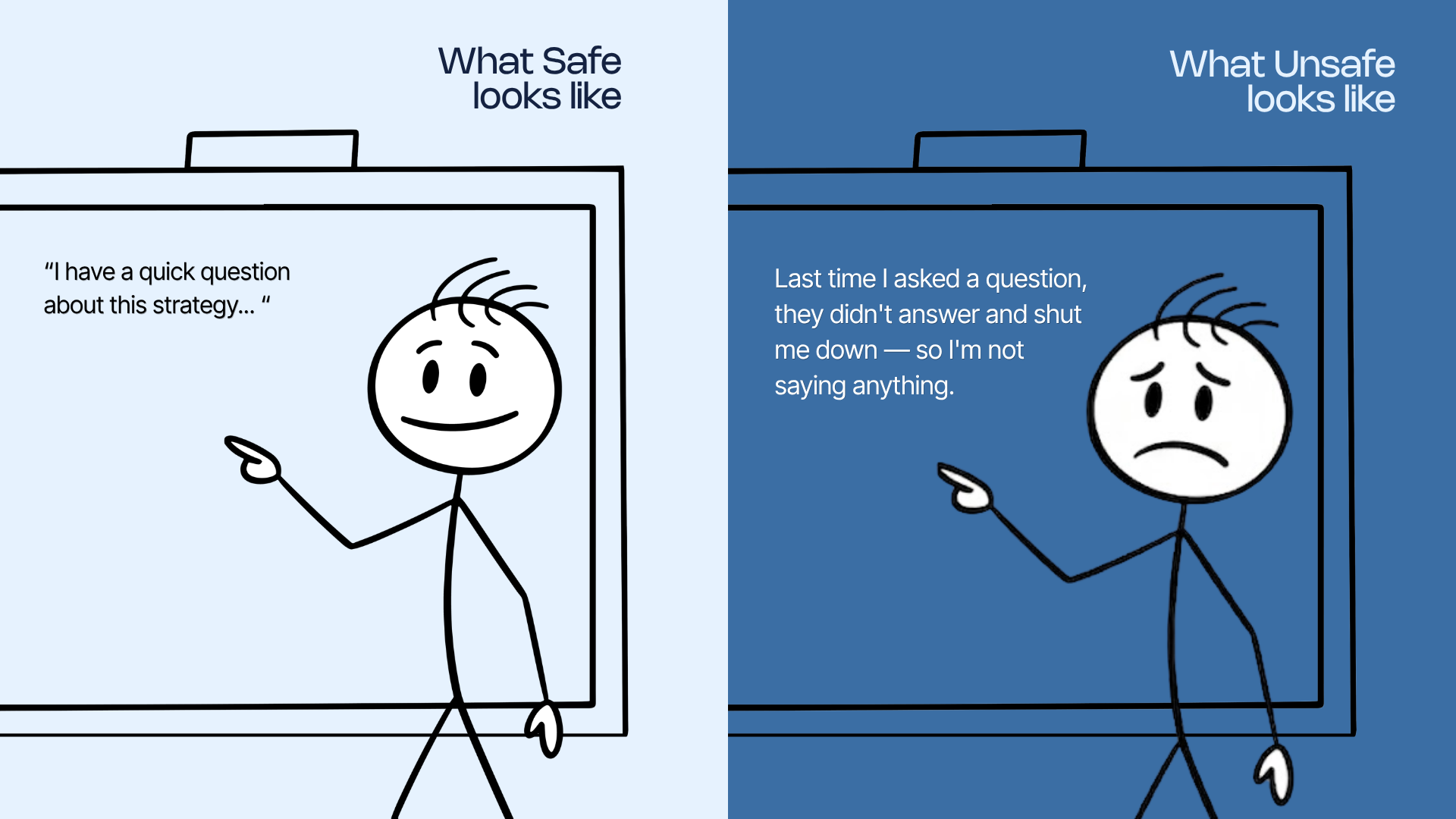
A two-panel illustration contrasts a stick figure asking a question in a "safe" workplace with the other figure staying silent in an "unsafe" workplace.
What Genuinely Safe Workplaces Do Differently
Workplaces that get psychosocial safety right do not simply implement policies and wait. They cultivate leaders who are genuinely curious about the individual experience of every person on their team. They create the conditions — through one-on-ones, open-door cultures, confidential support channels, and consistent role modelling — where individuals feel safe enough to tell the truth.
They also invest in helping individuals build their own psychological resources: self-awareness, boundary-setting, emotional regulation, and the capacity to seek support before reaching breaking point. Safety is not just something the organisation provides; it is something individuals are supported to actively participate in.
A Call to See the Person First
At Jay and Associates, we work with organisations who are ready to move beyond surface-level wellbeing initiatives and into the kind of deeply considered, individually responsive practice that creates genuinely safe workplaces.
Psychosocial safety starts at the policy and structural level — but it is only real when the individual person in front of you feels it in their bones. Safe to speak. Safe to struggle. Safe to be fully, authentically human at work.
Leaders need to be highly skilled communicators, have emotional intelligence to read the room and exceptional at navigating the complexity of team dynamics, modelling expected behaviours that set standards for psychological and psychosocial behaviours whilst meeting work output expectations.
Psychosocial safety is not about the warm and fuzzy in teams, it’s about robust, successful leadership and creating thriving teams that not only benefits teams, individuals but also an improvement in the organisations bottom line.
That is the standard worth working towards.
Jay and Associates specialise in psychosocial safety consulting, leadership development, and workplace wellbeing strategy. To find out how we can support your organisation, get in touch with our team today.